
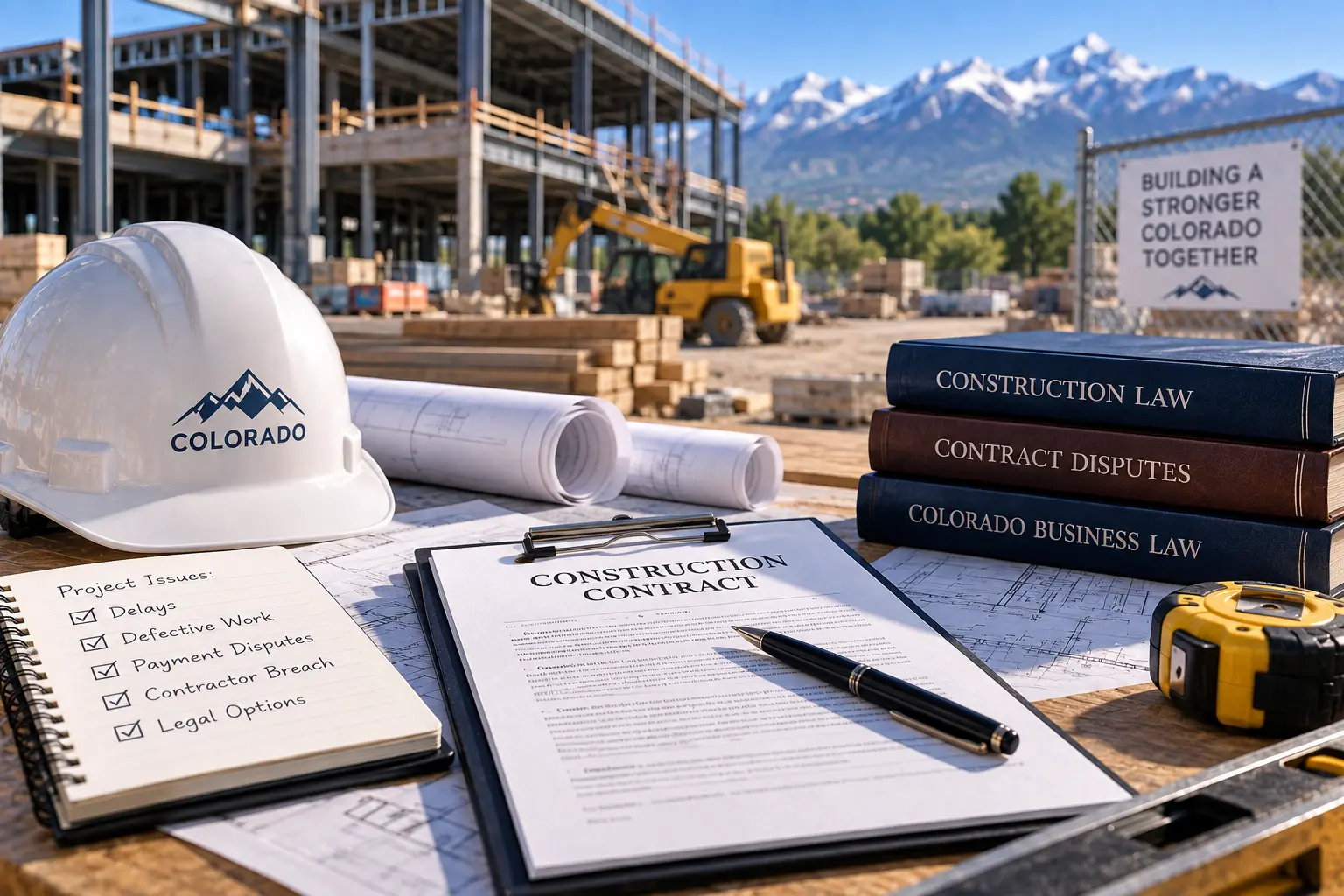
Colorado Construction Disputes: Contractor Breach Options
When a contractor breaches a construction contract in Colorado, businesses have legal remedies. Lear...
When a contractor fails to perform a commercial construction agreement, the problem can quickly become a business problem. Colorado construction disputes may involve abandoned work, defective construction, unauthorized substitutions, missed milestones, unpaid amounts, change-order disagreements, or failures to follow project requirements. The right response depends on the contract, the nature of the breach, the project status, and the losses involved.
For a Colorado business owner, the goal is not simply to prove that something went wrong. It is to preserve evidence, avoid creating a second breach, follow the contract’s notice and cure provisions, protect the property, and determine which remedies are actually available. This guide explains practical options when a contractor breaches a construction contract, including negotiation, cure demands, termination, replacement work, damages, liens and bonds, mediation, arbitration, and litigation.
A contractor’s failure to perform is not automatically enough to establish every remedy a business owner may want. The contract defines the parties’ obligations, and the legal significance of a failure depends on the language of the agreement, the extent of the nonperformance, any contractual cure rights, and applicable Colorado law.
The distinction between a material and lesser breach matters because the remedies available after a serious breach can differ from those available for a relatively minor deficiency. A failure that substantially defeats the purpose of the agreement may support termination or other stronger remedies, while a correctable deficiency may call for repair, completion, or compensation rather than ending the entire contract.
Do not label a breach ‘material’ simply because it is frustrating or expensive. Review the contract and the surrounding facts. A court or arbitrator may consider the nature of the promised performance, the importance of the obligation, whether the failure can be cured, and the resulting harm.
Before withholding money, terminating the contractor, or hiring someone else, identify the provisions that control the dispute. Construction agreements frequently allocate risk through detailed procedures, and Colorado appellate authority recognizes that parties in construction projects can use interrelated contracts to allocate rights, duties, risks, and remedies.
Colorado construction contracts can contain claim procedures that materially affect how a dispute must proceed. Colorado appellate authority concerning construction-contract claim procedures
Create a contemporaneous record before the project changes. Photograph and video incomplete or defective work, preserve plans and specifications, save inspection reports, collect invoices and payment records, and preserve emails, texts, meeting notes, schedules, daily reports, and change orders.
If the defect may be disputed later, consider an independent inspection or qualified expert evaluation before repair work obscures the original condition. For complex projects, an expert may also help distinguish defective workmanship from design problems, owner-directed changes, ordinary wear, or work performed by another trade.
Do not assume that a suspected breach gives you an unrestricted right to stop every payment. The contract may contain specific procedures for disputed amounts, retainage, notices, or payment applications. Withholding an undisputed amount or ignoring contractual procedures can create a counterclaim.
At the same time, Colorado construction projects can involve statutory lien and payment rules that make payment disputes time-sensitive. If a contractor or subcontractor has asserted a lien or claim against project funds, obtain legal advice before treating the dispute as an ordinary invoice disagreement.
If the agreement requires written notice of default, give notice exactly as the contract requires. Identify the relevant provision, describe the problem, preserve supporting evidence, state what cure or corrective action is requested, and follow any contractual deadline. Use the required delivery method rather than assuming an ordinary email is sufficient.
Address immediate safety or property-protection issues while preserving evidence. If temporary work is necessary to prevent further damage, document why it was necessary, who performed it, what it cost, and what the site looked like beforehand. Reasonable mitigation can matter when damages are later calculated.
A contractor that stops performing can leave a business with an incomplete project, exposure to additional costs, and uncertainty about how to proceed. Before treating the contract as terminated, determine whether the contractor actually abandoned the work, whether the contract provides a cure period, and whether there is an owner or contractor termination procedure.
A missed date is not automatically a compensable breach. Determine whether the schedule was contractually binding, whether extensions were permitted, and whether delays resulted from weather, permitting, owner changes, concealed conditions, other trades, force-majeure provisions, or other events addressed by the agreement.
If delay damages are important, examine any liquidated-damages clause and any limitation or exclusion of consequential damages. Lost revenue or other business losses may require detailed proof of causation, foreseeability, and reasonable certainty.
Defective work can range from cosmetic deficiencies to failures affecting the safety, function, or value of an improvement. Compare the actual work against the contract documents, applicable code requirements, approved submittals, and accepted change orders. An expert may be appropriate where the cause or scope of a defect is technically disputed.
Construction contracts commonly require written approval for changes in materials, scope, price, or schedule. Preserve the original specification, the contractor’s request or substitution, any approval or rejection, and the final work performed. The written change-order process can be central to determining whether additional work or substitutions were authorized.
Contract damages generally seek to compensate the nonbreaching party for losses caused by the breach, subject to the contract and applicable legal limits. In a construction dispute, potentially relevant losses can include reasonable costs to complete unfinished work, reasonable repair or replacement costs, certain additional project expenses, and other losses that can be legally attributed to the breach and proven with sufficient certainty.
Do not assume every business loss is recoverable. Contractual damage limitations may exclude consequential or incidental losses, and claimed lost profits or business interruption losses can face disputes over foreseeability, causation, certainty, and mitigation.
If the contract permits termination for cause and the contractor fails to cure a qualifying default, termination may allow the owner to engage another contractor. Follow the agreement’s termination procedure carefully. Obtain reasonable bids and preserve the basis for the replacement cost so the additional expense can be evaluated as a potential component of damages.
Money damages are the ordinary remedy for many contract disputes, but equitable relief can be available in appropriate cases. Whether a court should order a party to perform or refrain from an act depends on the facts, the contract, and the requirements for equitable relief. Do not assume specific performance is available simply because a contractor breached.
Colorado generally follows the American rule, meaning attorney fees are not automatically awarded to the prevailing party in an ordinary contract action. A fee award may be available when a valid contractual provision or applicable statute provides for it. Review the fee clause before estimating the economic value of a claim.
A contractor dispute can involve rights beyond the owner’s direct breach claim. Mechanic’s liens can create an interest against property for qualifying labor and materials, while payment bonds and other statutory remedies may provide additional avenues for recovery in some projects.
Colorado’s mechanic’s-lien statutes contain detailed notice, filing, and timing requirements. For example, C.R.S. § 38-22-109 governs lien statements and contains specific requirements for perfecting a lien. Missing a statutory deadline can jeopardize a lien claim.
Review C.R.S. § 38-22-109 on Colorado mechanic’s lien statements before relying on a lien remedy.
Public and certain private construction projects can involve bond requirements or statutory rules concerning project funds. The applicable remedy depends on the project type and the parties involved. A business owner should identify whether a surety, payment bond, lender, or other party may have obligations or rights before assuming the contractor is the only potential source of recovery.
If the project can still be completed successfully, a structured cure discussion may be more practical than immediate litigation. Define the deficiencies, the corrective work, the schedule, responsibility for costs, and the documentation required to confirm completion.
Mediation is a voluntary dispute-resolution process involving a neutral third party. Colorado courts may refer cases to mediation, and parties can also agree to mediate before or during litigation. A construction contract may independently require mediation before arbitration or litigation.
Colorado Judicial Branch mediation information explains that mediation can be used even before an active court case in appropriate circumstances.
If the construction contract contains an arbitration clause, determine exactly which claims are covered, whether pre-arbitration notice or mediation is required, and what forum and rules apply. Arbitration can be binding, and the contract may limit the ability to pursue the dispute in court.
A demand letter can consolidate the factual record and identify the remedy sought. It should be consistent with the contract’s notice provisions and avoid unsupported threats or demands. For a substantial dispute, counsel can help frame the claim, preserve defenses, and address settlement terms without waiving rights.
Litigation may become appropriate when the contractor refuses to cure a qualifying breach, negotiations fail, contractual dispute procedures have been completed, urgent court relief is necessary, or a filing deadline is approaching. The decision should account for the contract, amount at stake, collectability, evidence, project needs, and available remedies.
Colorado generally provides a three-year limitations period for contract actions under C.R.S. § 13-80-101(1)(a), measured from accrual of the cause of action. That is not a universal deadline for every construction-related claim.
C.R.S. § 13-80-101 provides the general three-year rule for contract actions.
Claims against architects, contractors, builders, engineers, inspectors, and others arising from deficiencies in the design or construction of an improvement to real property can be subject to the specialized rules in C.R.S. § 13-80-104. The statute includes a discovery-based limitations framework and, generally, a six-year statute of repose measured from substantial completion, with special rules for claims arising during the fifth or sixth year.
C.R.S. § 13-80-104 contains those construction-specific limitations and repose rules.
Because the applicable deadline can depend on whether the claim is a straightforward contract action, a construction-defect claim, a warranty claim, or another theory, do not rely on a generic three-year statement without analyzing the actual claim.
Insurance should be reviewed separately from the underlying breach claim. A contractor’s commercial general liability policy may not cover every allegation of defective workmanship, and coverage depends on the policy language and the facts. Likewise, a business owner’s own policy may address some property losses while excluding others. Do not assume that the existence of insurance guarantees recovery.
A contractor breach can affect far more than the construction site. It can delay a business opening, increase project costs, disrupt operations, and create disputes over payment, defective work, or responsibility for delays. Early legal review can help a business owner understand the contract, preserve evidence, follow required procedures, and evaluate practical resolution options.
High Plains Law represents Colorado businesses in commercial disputes and contract matters. Learn about High Plains Law’s business litigation services or contact High Plains Law to discuss a construction-related dispute.
Possibly, but the contract and the nature of the breach matter. Review any default, cure, and termination provisions before terminating. A material breach may support stronger remedies, but an improper termination can create a counterclaim or expose the owner to additional liability.
Not automatically. Review the payment provisions, disputed-payment procedures, retainage terms, notice requirements, and the extent of the contractor’s breach. Withholding money without following the contract can create a separate dispute. A lawyer can help determine which amounts, if any, can properly be withheld.
Many contract actions are subject to a three-year limitations period under C.R.S. § 13-80-101, but construction-defect claims involving improvements to real property can be governed by different limitations and repose rules under C.R.S. § 13-80-104. The correct deadline depends on the claim and facts.
Potentially. If the original contractor’s breach legally supports replacement work, reasonable additional completion or repair costs may be recoverable as damages, subject to the contract, causation, mitigation, and proof requirements. Keep competing bids, invoices, and records explaining the replacement scope.
Possibly, but lost income is not automatically recoverable. The claim may depend on foreseeability, causation, reasonable certainty, mitigation, and contractual limitations on consequential damages. Strong financial records and project documentation are important.
Sometimes. A contract may require mediation before arbitration or litigation, and a court can also refer a case to mediation. Colorado does not impose a universal rule that every construction dispute must be mediated before a lawsuit can be filed.
Treat the lien as a separate time-sensitive issue. Colorado’s mechanic’s-lien statutes contain detailed requirements for notices, lien statements, filing, and enforcement. Review the lien promptly and avoid assuming that the underlying breach dispute automatically resolves the lien.
Not every dispute requires an expert, but experts can be important when the case involves technical defects, code compliance, causation, construction standards, scheduling, or the cost to repair or complete work. An early inspection can also help preserve evidence before repairs change the site.
This article is provided for general informational purposes only and is not legal advice. Construction disputes are highly fact-specific, and deadlines, remedies, notice requirements, lien rights, insurance issues, and contractual procedures can vary by project and claim. Reading this article does not create an attorney-client relationship with High Plains Law. Consult a Colorado attorney about your specific circumstances.
Disclaimer: This article is provided by High Plains for general informational purposes only and does not constitute legal advice. Reading this content does not create an attorney-client relationship. Laws, fees, regulations, and court decisions referenced may change. For advice on your specific situation, please contact High Plains directly to schedule a consultation.



High Plains Law is a division of Gessler Blue LLC. All legal services are provided through Gessler Blue LLC.
The content on this website is not legal advice and is intended for general informational purposes only.
No attorney-client privilege is formed by use of this website or the content hereon.
Copyright High Plains Law LLC. Attorney advertising.
The content on this website is not legal advice and is intended for general informational purposes only.
No attorney-client privilege is formed by use of this website or the content hereon.